If you price out Odoo.sh, the calculator shows you something like $57.80 a month and it feels fine. The catch is in small print directly under the sliders: “The hosting price does not include the enterprise licence.” The licence is the per-user part, and for any team bigger than one or two people it’s most of the bill.
We host Odoo Community instead, and charge a flat price per instance. Not because we’re being generous — Community’s licence (LGPLv3) simply has no per-user term, so there’s nothing to meter. This page goes through the numbers, which I pulled from Odoo’s pricing pages this morning so they’re current, and then the part where I tell you what you’d be giving up, because there is one.
The two meters on an Odoo.sh bill
Here’s their calculator as of today (USD, annual billing — monthly runs about 25% higher):
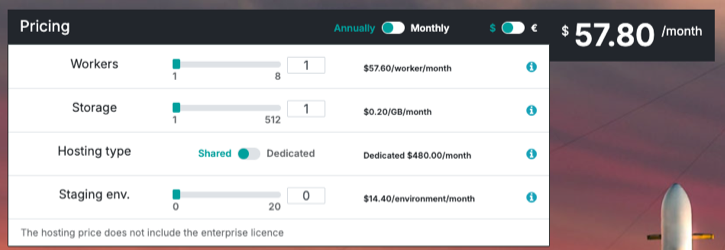
| Component | Price |
|---|---|
| Worker | $57.60 / worker / month |
| Storage | $0.20 / GB / month |
| Staging environment | $14.40 / environment / month |
| Minimum configuration | $57.80 / month |
Then the licence. Odoo.sh only runs Enterprise, and Enterprise is priced per user — US list is $24.90–$38.90 a user on Standard, $49–$76 on Custom, and Odoo.sh deployments need Custom. So for a ten-person company the realistic bill looks like:
Hosting   1 worker + 10 GB               $59.60 / month
Licence   10 users × $49 (Custom, US)   $490.00 / month
                                        ─────────────────
                                        $549.60 / month
Hire one more person and the bill goes up $49. Nothing about the server changed. That’s the meter working as designed — it’s just worth seeing clearly before you’re on it.
What we charge instead
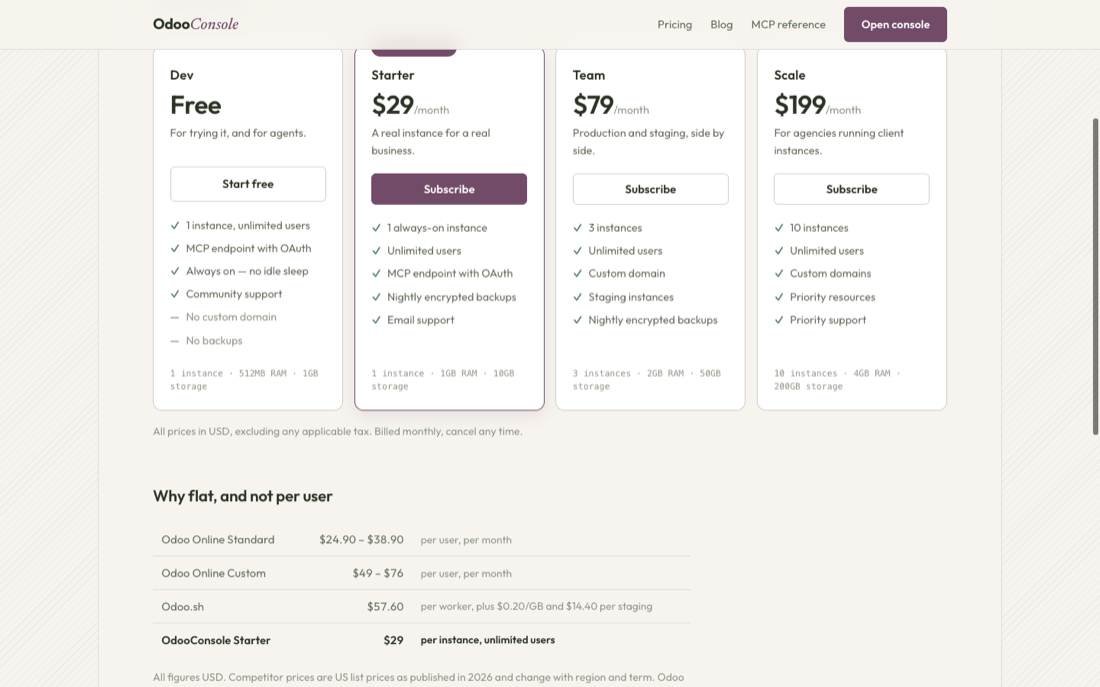
| Plan | Price | What you get |
|---|---|---|
| Dev | Free | 1 instance, 512 MB, 1 GB storage — sleeps when idle |
| Starter | $29 / month | 1 always-on instance, 1 GB RAM, 10 GB, nightly backups |
| Team | $79 / month | 3 instances, 2 GB RAM, 50 GB |
| Scale | $199 / month | 10 instances, 4 GB RAM, 200 GB |
That same ten-person company is $29 a month on Starter, and the eleventh hire costs nothing. What moves you up our plans is memory, storage and instance count, because those are the things that actually cost us money.
One caveat I’d rather make myself than have you discover: fifty people hammering one instance at the same time will eventually want more than Starter’s 1 GB of RAM. At that point you’re upgrading for the load, not the headcount — but you are upgrading.
What you give up
Community is not Enterprise with the price filed off.
No Studio, and none of the Enterprise-only modules. If your workflow leans on them, Odoo’s own hosting is the right choice and I’d genuinely rather you figure that out now.
No git workflow. Odoo.sh is also a development platform — push a branch, get a staging build. We don’t do that. Our version of staging is a second instance, included from the Team plan up. If you’re doing heavy custom module development you’ll notice; if you’re running Odoo as a business system you probably won’t.
And there’s a ceiling. Odoo.sh sells up to 8 workers and dedicated hosting. Our biggest instance today is 4 GB of RAM. Some deployments are just bigger than us, for now.
What you get that they don’t have: every instance here exposes an MCP endpoint, so Claude or Cursor or any MCP client can work your ERP over an authorised connection. Setup is pasting one URL. It works on the free tier.
Run your own numbers
Both pricing pages are public — theirs, ours. Put your headcount into the example above. The crossover is at about two users, and it gets wider with every hire. If you want to check whether Community actually covers what you use, a free Dev instance is the fastest way to find out.